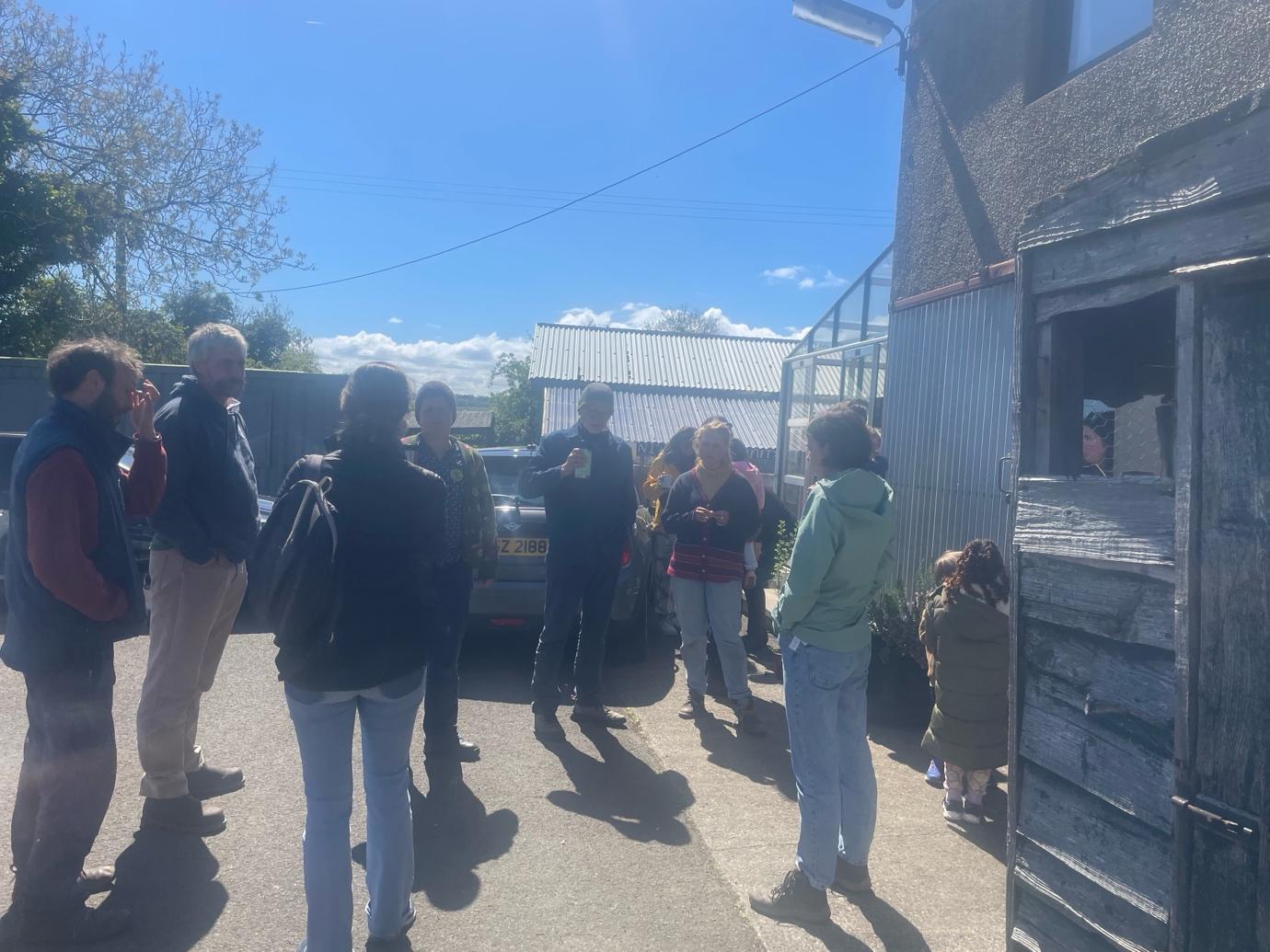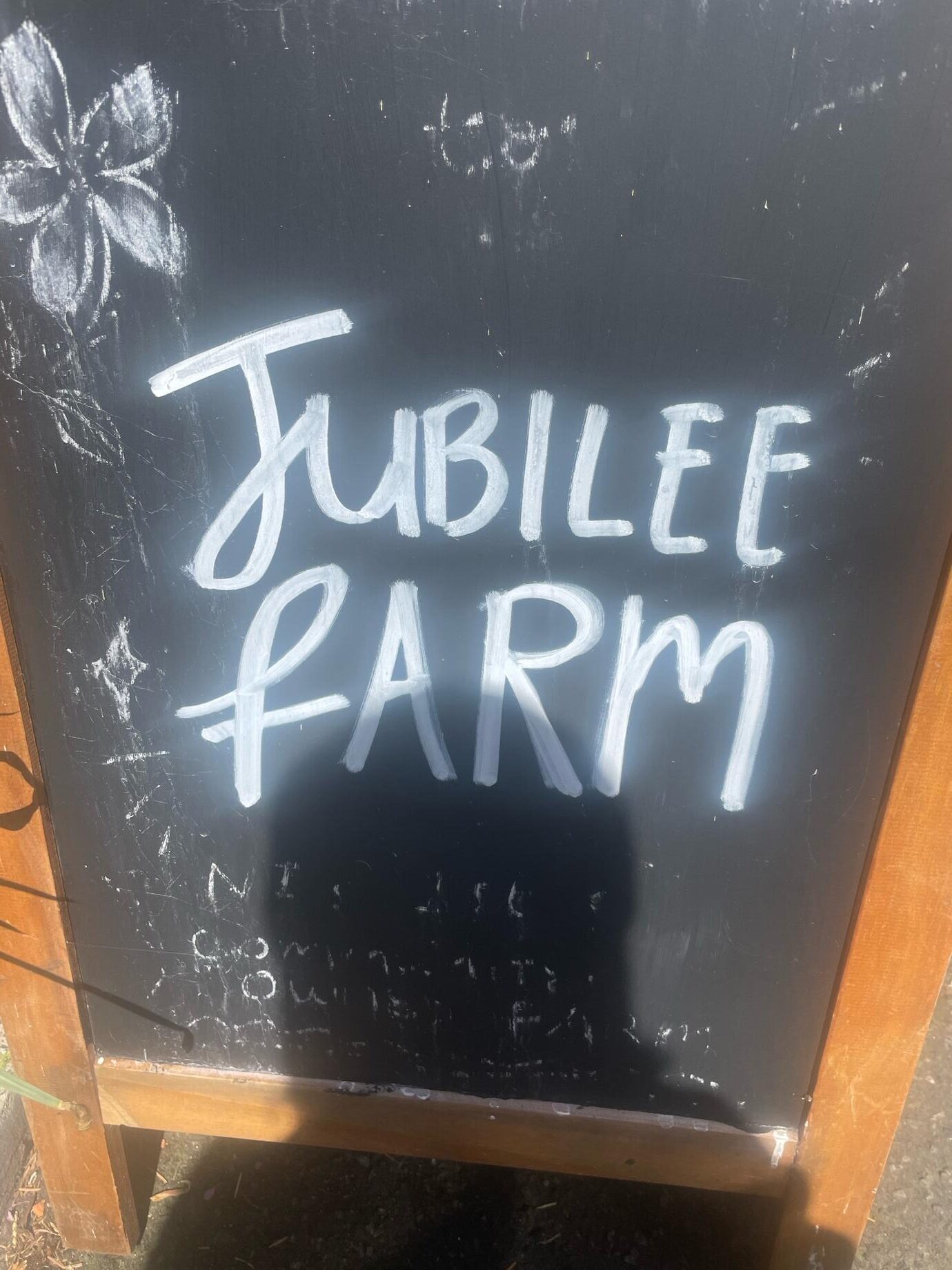
On Saturday 9 May, Barry and I took part in the CSA Network Gathering at Jubilee Farm, the first community owned farm in Northern Ireland.
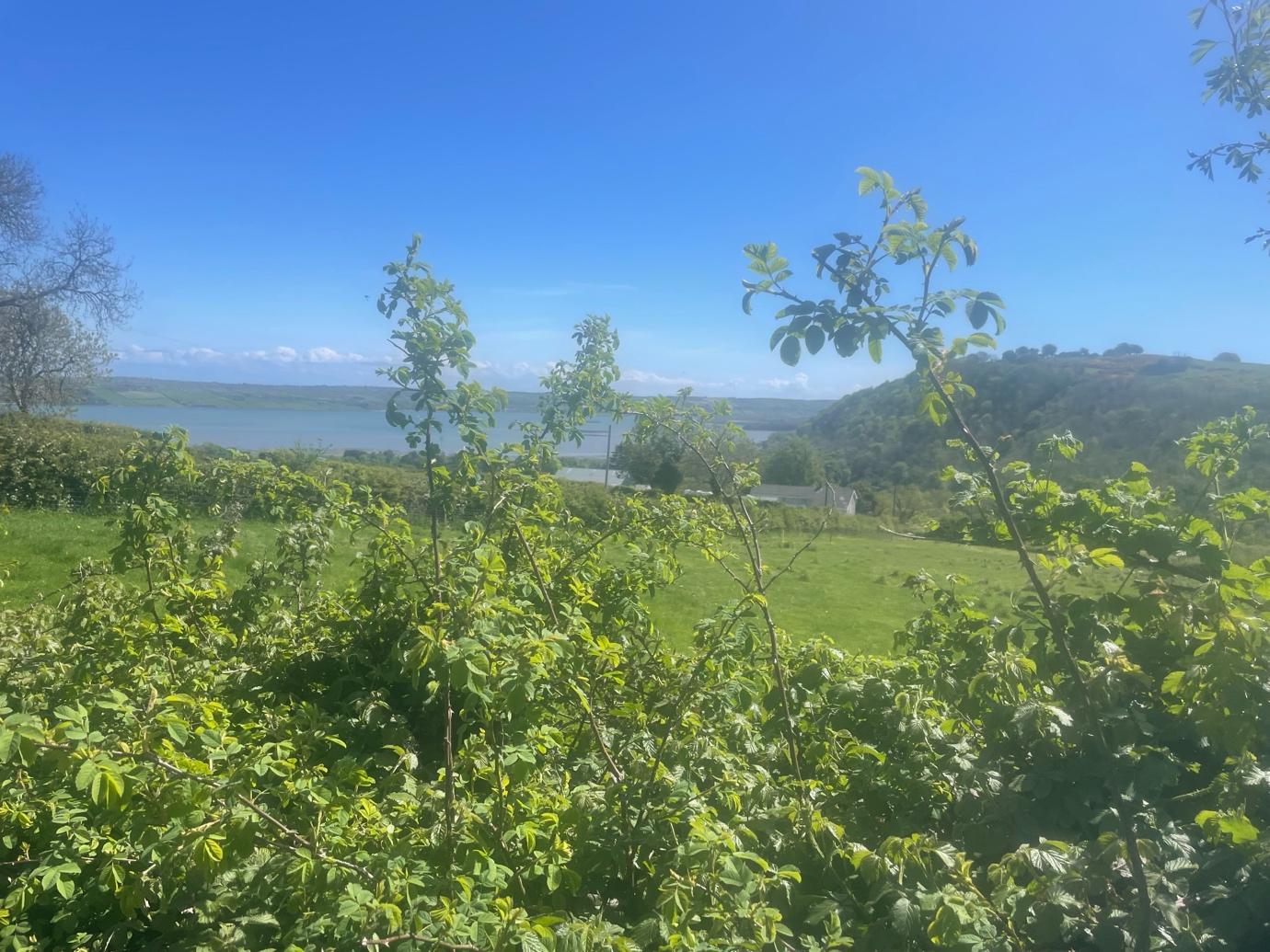
Jubilee Farm is in Glynn, just outside Larne and looks out over Larne Lough. The organisation is a cooperative and social enterprise. Their ethos is ‘guided by ‘creation care’, that is environmental & agricultural stewardship which incorporates fairness and flourishing, welfare & wellbeing, from the soil to the animals, to biodiversity, to what we grow, to the people that visit.’
Community Supported Agriculture is integral to how Jubilee Farm operates with opportunities to volunteer on Tuesdays and the last Saturday of each month. We were hosted by Tim, the Farm Manager, Jude, who has recently taken on the role of Chair of their board, David, who is a longstanding board member and Portia, who is a volunteer and former employee.
The day was coordinated by Jo from Laurelbank farm and our own Barry Ferguson and we heard from Jo, Jude, Barry and Davie, Alice and Jemima from Cloughjordan community farm. Davie is also involved in Feeding Ourselves, an annual gathering and community of practice focused on agroecology, food sovereignty, and local resilience in Ireland. We also heard from Holywood CoFarm, ‘a not-for-profit group running community-led food growing project to promote health and wellbeing, grow resilience in the community and support sustainable local food production’.
I also talked a little about what we are trying to do to connect the agroecology movement across NI – and ideally working with Cultivate and others to connect across the whole island.
It was great to hear about the important work going on across the island and although our numbers are small at the minute, nothing ever got started without some people giving things a go against the odds!
We were sorry that some other farms who had signed up were unable to join us but this is also the reality of where we are. All of us are juggling so many projects and responsibilities with very stretched resources, which can make it hard to set time aside to connect with others and put energy into building something bigger than any of us. We have used some of our Farming the Future grant to pay for people to attend events and training, such as the recent permaculture training at Barry’s farm. It’s important that funders recognise that we can only build a movement if we are able to resource people to come together, which includes paying them to attend or make up for the money they would have earned had they not attended.
I left the day as ever feeling the benefit of the human and nature connection when I attend events like this. But I also left feeling frustrated and a bit bewildered that we remain on the fringes and that the scale of the urgent change is not understood or appreciated by those who have the power and resources to change things.
I was also struck by one theme that emerged during the day around financial viability. Of course, this is on our mind at Carrick Greengrocers as we approach our 3rd anniversary and continue to think about how to ‘make things work’. At our second AGM we acknowledged that we need around 10% of our income to be generated from sources other than trading. Initially that felt like a failure but I have come to realise that the forces we are up against have been allowed by successive governments to become so strong over the last 30-40 years that actually it’s something of a miracle that we are able to generate 90% of our income through trading!
When I look at many small businesses around us in Carrick, some are subsidised in some way through redundancy payments that allow people to follow their dreams (and absorb losses at least to start with) or by a partner earning a full-time wage. I imagine this is the case across other small businesses and it’s fine because people are doing what they love and are earning enough to live on. They aren’t interested in taking over the world and making obscene amounts of money. And these are small businesses that are operating within the status quo – not trying to contribute to changing things for the better.
Then if you look at big tech companies, particularly AI companies, they seem to be struggling to make a profit and there is much talk of an AI bubble. And a quick google shows that Disney’s streaming service is struggling to make a profit so far. I’m left wondering whether the dominant story about business is really a story about how things are supposed to work, rather than a story about how things do work in practice. Then of course we are living in a time when so many big corporations like Deloitte or Serco are making so much ‘delivering’ on behalf of the public sector. Is that a ‘successful business’? What about conventional farms who receive public subsidies and could not survive without them? Barry and I were reminded of a meeting at Helen’s Bay Organics a couple of years ago where DAERA officials demanded that we demonstrate we are financially viable in order for them to develop policies that support the growth of the agroecological sector. Somehow we are being held to a much higher standard than conventional farming, other small businesses or big corporations that profit from misery while destroying our public services.
So I think there is some work for us to do to change our minds on financial viability and what a successful business looks like in these strange times. In order for us to acknowledge the truth of our financial status in the greengrocers, I had to let go of some shame about not being able to make it work and I got a sense of that shame in the room on Saturday. We need to let that go and marvel at what we have managed to do despite the massive forces against us – and to develop a story that challenges the dominant story about successful businesses for new entrants to the agroecology sector.
Acknowledging the power of those forces is exactly why we need to adopt different models, such as the cooperative model, and new ways of being and thinking. The cooperative model invites in what we currently call ‘volunteers’ but actually they are members of the community, and we all benefit from making space for as many people to take part. These models allow us to take more risks and innovate, exploring different ways to generate income, as Jo is doing at Laurelbank Farm, while building relationships and changing our own and others’ lives. We are the innovators. We are derisking agroecology businesses of the future. It’s frustrating that this isn’t recognised but that won’t stop us!